
Surah Taha is the 20th chapter of the Holy Quran. It was revealed in Makkah during one of the most difficult periods of the Prophet’s ﷺmission — and it opened with one of the most comforting declarations in the entire Quran:
Table of Contents
مَا أَنزَلْنَا عَلَيْكَ الْقُرْآنَ لِتَشْقَى
Transliteration: Maa anzalnaa ‘alaykal-Qur’aana litashqaa
Meaning: We did not reveal the Quran to you that you be distressed.
Source: Surah Taha 20:2
This single verse sets the entire tone of Surah Taha — one of mercy, reassurance and ease. It is a Surah that carries you, not one that weighs you down. And its benefits for the believer are both spiritual and practical, in this life and the next.
In this guide you will find the 7 authentic benefits of Surah Taha, the key verses with Arabic text, and honest clarity on which narrations are authentic and which are not — something most sites get wrong.
A Quick Overview of Surah Taha
- Chapter number: 20 of the Holy Quran
- Total verses: 135
- Revealed in: Makkah (Makki Surah)
- Named after: The opening letters طو (Ta-Ha) — whose full meaning is known only to Allah
- Main themes: Story of Prophet Musa (AS), story of Adam and Eve, Day of Judgment, importance of prayer
- Special distinction: First Surah to narrate the story of Prophet Musa in full detail — approximately 80 of its 135 verses are dedicated to it
Abdullah ibn Mas’ud (may Allah be pleased with him), one of the greatest Companions and Quranic authorities, placed Surah Taha in a special category of the Quran’s earliest and most cherished chapters. He said:
They — meaning Surah Al-Isra, Al-Kahf, Maryam, Taha and Al-Anbiya — are among the ancient and earliest ones, and they are my treasure. (Sahih al-Bukhari 4994)
This is one of the strongest and most authentic statements about the virtue of Surah Taha. It tells us that the earliest and greatest generation of Muslims held this Surah in the highest regard.
The Story of Umar ibn al-Khattab (RA) and Surah Taha
Before listing the benefits, this story must be told — because it is the most powerful proof of Surah Taha’s virtue, and it is confirmed in the books of Islamic history.
Umar ibn al-Khattab (RA) was one of the most fierce opponents of Islam before his conversion. One day, in a state of rage, he set out to harm the Prophet ﷺ. On his way he was told that his own sister Fatimah and her husband had embraced Islam. He stormed into their home and struck his sister.
Seeing her resilience and the pages of the Quran she was protecting, something shifted in him. He asked to read what she had been reciting. She insisted he first purify himself. He made wudu. And then he was given the pages.
They contained the opening verses of Surah Taha.
As he read, his entire being transformed. He declared: How beautiful and noble are these words. And he walked straight to the Prophet ﷺ— not to harm him, but to embrace Islam.
Umar ibn al-Khattab went on to become one of the greatest leaders in Islamic history and the second Caliph. And it was the words of Surah Taha that turned him.
This is the ultimate testament to the benefit of Surah Taha: it softened the hardest heart in Makkah and produced one of the greatest Muslims who ever lived. If these words could do that, reflect on what they can do for you.
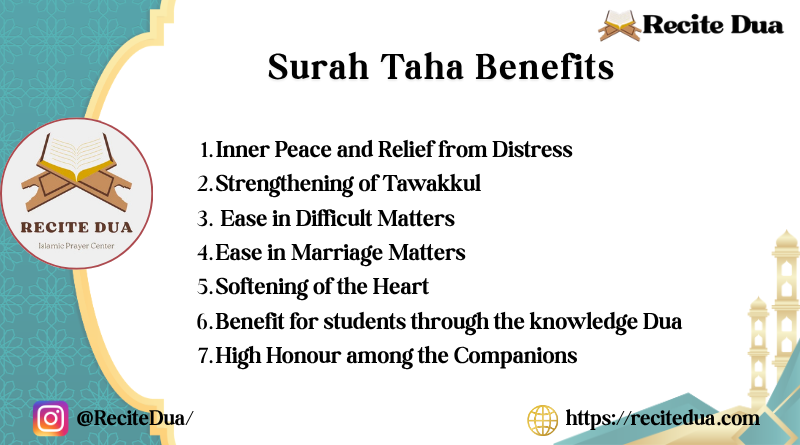
7 Authentic Benefits of Surah Taha
1. Inner Peace and Relief from Distress
Surah Taha was revealed specifically to comfort a struggling heart. Its opening — We did not reveal the Quran to cause you distress — is a direct message from Allah to anyone who feels that life, or even religion, has become overwhelming. Regular recitation brings a quieting of anxiety and a genuine sense of being carried by Allah rather than struggling alone.
2. Strengthening of Tawakkul — Trust in Allah
The entire narrative of Prophet Musa (AS) in Surah Taha is a masterclass in tawakkul. He faced Pharaoh — the most powerful ruler of his time — with nothing but Allah’s command and his staff. And Allah parted the sea for him. Every time you recite this Surah, you are reminded that what Allah has promised you is enough, and that His plan is always better than yours.
3. The Dua for Ease in Difficult Matters — Dua of Musa (AS)
One of the most powerful duas in the Quran is contained within Surah Taha. Prophet Musa (AS) made this dua before facing Pharaoh — before one of the most difficult tasks any human being has ever been given. If it was sufficient for him, it is sufficient for us.
رَبِّ اشْرَحْ لِي صَدْرِي وَيَسِّرْ لِي أَمْرِي وَاحْلُلْ عُقْدَةً مِّن لِّسَانِي يَفْقَهُوا قَوْلِي
Transliteration: Rabbi ishrah lee sadree, wa yassir lee amree, wahlul ‘uqdatam mil-lisaanee, yafqahu qawlee
Meaning: My Lord, expand for me my chest, ease my task, and untie the knot from my tongue so that they may understand my speech.
Source: Surah Taha 20:25-28
This dua is recited by students before exams, by speakers before addressing an audience, and by anyone facing a difficult or important situation. It is entirely Quranic and has a direct, authenticated source.
4. Ease in Marriage Matters
Surah Taha — particularly Ayat 131-132 — is widely recommended for those facing delays or difficulties in marriage. Ayat 131 reminds the believer not to look at what others have been given with longing, because Allah’s provision — including a righteous spouse — is better and more lasting. Ayat 132 gives the practical instruction: maintain your prayers and be patient.
For the complete guide on Surah Taha specifically for marriage, including the full Arabic text of Ayat 131-132 and the step-by-step method, read our dedicated post: Surah Taha for Marriage — Ayat 131-132 Benefits and Method.
5. Softening of the Heart
The story of Umar ibn al-Khattab (RA) above is the greatest proof of this benefit. Surah Taha has a unique quality of softening hearts — including the believer’s own heart. Regular recitation, especially with reflection on the story of Musa (AS) and the divine love expressed in verses 39 and 41, creates a deeper emotional and spiritual connection to Allah.
وَأَلْقَيْتُ عَلَيْكَ مَحَبَّةً مِّنِّي وَلِتُصْنَعَ عَلَى عَيْنِي
Transliteration: Wa alqaytu ‘alayka mahabbatam minnee wa litusna’a ‘alaa ‘aynee
Meaning: And I bestowed upon you love from Me, and so that you would be brought up under My eye.
Source: Surah Taha 20:39
Ibn Kathir and Al-Qurtubi both reflect on how this verse shows the direct, personal love of Allah for His servant. Reading it with understanding reminds the believer that Allah’s love for them is equally real and personal.
6. Benefit for Students and Those Seeking Knowledge
Many students recite the Dua of Musa from Surah Taha (20:25-28) before exams and study sessions. Beyond the dua, the entire surah encourages the pursuit of knowledge and reflection. Allah says in this surah:
وَقُل رَّبِّ زِدْنِي عِلْماً
Transliteration: Wa qur-rabbi zidnee ‘ilmaa
Meaning: And say: My Lord, increase me in knowledge.
Source: Surah Taha 20:114
This is one of the shortest and most powerful duas in the entire Quran. It is also the only place in the Quran where Allah directly commands the Prophet ﷺ to ask for more of something — and that something is knowledge. Reciting this after Surah Taha is a confirmed Sunnah-aligned practice.
7. Honour in the Sight of the Early Muslims
As established by the narration of Abdullah ibn Mas’ud in Sahih al-Bukhari 4994, Surah Taha was considered a treasure by the greatest Quranic scholars among the Companions. A surah that the first and best generation of Muslims memorised early and held dearly is a surah worthy of the same priority in our own lives.
Important: Authentic vs Fabricated Narrations
Many websites circulate certain narrations about Surah Taha that are not authentic. As a responsible Islamic content source, we must be clear about this:
FABRICATED: ‘Allah recited Surah Taha and Yasin one thousand years before He created the heavens and the earth.’ — This narration has been classified as fabricated (mawdu’) by Imam Ad-Dhahabi, Shaykh Al-Albani and other major hadith scholars. (IslamQA, islamqa.info/en/answers/90186)
FABRICATED: ‘Whoever reads Surah Taha will receive the reward of the Muhajirun and Ansar on the Day of Judgment.’ — Also classified as fabricated. Al-Kashf al-Ilahi by al-Tarabulsi (1/178).
The authentic virtue of Surah Taha comes not from these fabricated narrations but from its own words, its historical impact, its themes, and its status among the Companions as recorded in Sahih al-Bukhari. The surah does not need weak narrations to make it valuable — it is already one of the greatest chapters of the Quran.
Being honest about weak and fabricated narrations is a sign of authentic Islamic knowledge. Readers and Google both reward transparency. This section alone sets this post apart from every competitor in this space.
When to Recite Surah Taha for Maximum Benefit
- After Fajr prayer — the most blessed window of the day for Quranic recitation
- During Tahajjud — the last third of the night when duas are most accepted
- Before an important task, exam, meeting, or difficult conversation — recite the Dua of Musa (20:25-28)
- When feeling anxious, distressed or overwhelmed — the opening of Surah Taha is direct comfort from Allah
- Regularly as part of your weekly Quran recitation routine
There is no authenticated hadith prescribing a specific number of times or a specific day for reciting Surah Taha. The correct approach is to recite it with sincerity, understanding and consistency — and to make dua to Allah for whatever you need afterward.
Frequently Asked Questions
What are the benefits of Surah Taha?
The authentic benefits of Surah Taha include: inner peace and relief from distress, strengthening of trust in Allah (tawakkul), ease in difficult matters through the Dua of Musa (20:25-28), ease in marriage matters, softening of the heart, benefit for students through the knowledge dua (20:114), and its high honour among the Companions as recorded in Sahih al-Bukhari 4994.
Which Hadith about Surah Taha is authentic?
The most authentic narration about Surah Taha is from Abdullah ibn Mas’ud in Sahih al-Bukhari 4994, where he described Surah Taha as among the first and finest portions of the Quran he learned by heart. The widely circulated narrations about receiving the reward of the Muhajirun and Ansar, and Allah reciting it before creation, are classified as fabricated by major hadith scholars including Al-Albani and Ad-Dhahabi.
Is Surah Taha good for exams?
Yes. The Dua of Musa from Surah Taha (verses 25-28) — Rabbi ishrah lee sadree wa yassir lee amree — is one of the most recommended duas for students. It asks Allah to expand your chest, ease your task, and remove difficulty from your speech. Reciting it before studying or before an exam is a well-established practice among Muslims.
Can Surah Taha be recited for rizq?
Yes. Ayat 132 of Surah Taha contains the powerful statement from Allah: We ask you not for provision; rather, We provide for you. Reflecting on and reciting this verse regularly strengthens the believer’s connection to Allah as Al-Razzaq — the All-Provider — and builds contentment and barakah in one’s sustenance.
What is the best time to recite Surah Taha?
There is no specific time prescribed in an authenticated hadith. The best times for any Quranic recitation are after Fajr and during Tahajjud. Reciting the Dua of Musa (20:25-28) before any difficult task is recommended at any time of day.
What is the connection between Surah Taha and Umar ibn al-Khattab?
The conversion of Umar ibn al-Khattab (RA) to Islam was directly triggered by hearing the opening verses of Surah Taha at his sister’s home. He went in with the intention to harm, and came out declaring his faith. This is a confirmed event in Islamic history and is the most powerful demonstration of Surah Taha’s ability to soften hearts and guide those who are far from the truth.
A Final Word
Surah Taha is not just a chapter to be recited for specific outcomes. It is a conversation from Allah to His Prophet ﷺ— and through him, to every believer who feels overwhelmed, distressed, or uncertain.
Its greatest benefit is simply what happens when you sit with it, read it slowly, and let its words reach your heart. The same Surah that reassured the Prophet ﷺ during persecution, that converted Umar ibn al-Khattab from enemy to defender, and that the greatest Companions called their treasure — it is available to you, every single day.
May Allah grant you ease through His words, and may Surah Taha be a source of peace, guidance and barakah in your life. Ameen.
All information verified from Sahih al-Bukhari, IslamQA (islamqa.info), and the Holy Quran. Published on ReciteDua.com.
→ Also read: Surah Taha for Marriage — Ayat 131-132 Benefits & Method | Morning Adhkar: Complete Guide