
Think about the very first moment you wake up every morning. Before you check your phone, before you think about work, before the day makes its first demand — there is a brief, quiet moment between sleep and consciousness.
The Prophet Muhammad ﷺ never let that moment pass without the remembrance of Allah.
Table of Contents
The very first words he spoke upon opening his eyes were words of gratitude. Not because he had been instructed to perform a ritual, but because he genuinely understood what had just happened: his soul, which had been taken from his body during sleep, had been returned to him by Allah’s mercy. That is not a small thing. That is a resurrection, repeated every single morning.
The dua after waking up — known as uthne ki dua or so kar uthne ki dua in Urdu — is the first act of worship a Muslim can perform each day. It takes less than ten seconds. And the Prophet ﷺsaid it every morning of his life without exception.
In this complete guide, you will find every authentic dua for waking up with full Arabic text, transliteration, English meaning, and verified Hadith source. You will also find the complete Sunnah acts of waking up that transform your morning from a routine into an act of ibadah from the very first breath.
Bismillah. Let us begin.
Why Is the Dua After Waking Up So Important in Islam?
To understand why the dua after waking up matters so deeply, you first need to understand what Islam says about sleep itself.
Sleep in Islam is not simply rest. It is described as a minor death. Allah says in the Quran:
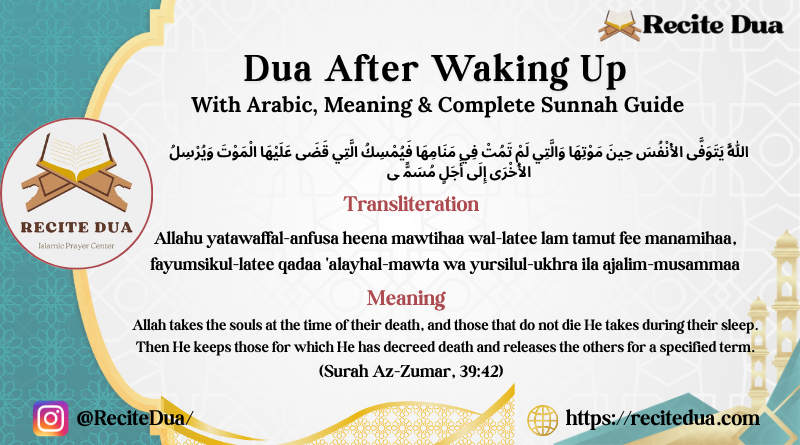
اللَّهُ يَتَوَفَّى الأْنْفُسَ حِينَ مَوْتِهَا وَالَّتِي لَمْ تَمُتْ فِي مَنَامِهَا فَيُمْسِكُ الَّتِي قَضَى عَلَيْهَا الْمَوْتَ وَيُرْسِلُ الأُخْرَى إِلَى أَجَلٍ مُسَمًّى
Transliteration: Allahu yatawaffal-anfusa heena mawtihaa wal-latee lam tamut fee manamihaa, fayumsikul-latee qadaa ‘alayhal-mawta wa yursilul-ukhra ila ajalim-musammaa
Meaning: Allah takes the souls at the time of their death, and those that do not die He takes during their sleep. Then He keeps those for which He has decreed death and releases the others for a specified term.
Source: Surah Az-Zumar, 39:42
This means that every morning you wake up, Allah made a specific decision to return your soul to you. He did not have to. He chose to. And the correct response to that decision — the response the Prophet ﷺ demonstrated — is immediate gratitude and acknowledgement.
That is exactly what the dua after waking up is. It is not a formality. It is a genuine, heartfelt recognition that the day you are about to live is a gift you did not earn and cannot take for granted.
The Complete Dua After Waking Up — Arabic, Transliteration & Meaning
1. The Primary Uthne Ki Dua — Alhamdu Lillahil-Ladhi Ahyana
This is the main dua after waking up — the one the Prophet ﷺ recited every single morning upon opening his eyes. It is the uthne ki dua that every Muslim should know by heart, because it is the most important first act of every single day.
الْحَمْدُ للَّهِ الَّذِي أَحْيَانَا بَعْدَ مَا أَمَاتَنَا وَإِلَيْهِ النُّشُورُ
Transliteration: Alhamdu lillahil-ladhee ahyaana ba’da ma amaatana wa ilayhin-nushoor
Meaning: All praise is for Allah who gave us life after causing us to die, and to Him is the resurrection.
Source: Sahih al-Bukhari 6312, Sahih Muslim 2711
How many times: Once, immediately upon waking — before getting out of bed
Hadith: Hudhayfah narrated: When the Prophet ﷺwoke up from sleep, he would say: All praise is for Allah who gave us life after causing us to die, and to Him is the resurrection. (Sahih al-Bukhari 6312)
The phrase wa ilayhin-nushoor — and to Him is the resurrection — is deeply significant. Every morning this dua reminds you that just as Allah returned your soul after sleep, He will also raise you from death on the Day of Resurrection. It turns a simple awakening into a daily reminder of the Hereafter.
2. Dua for Health After Waking — Alhamdu Lillahil-Ladhi Aafaani
This second authentic dua specifically asks for health and wellbeing at the start of the day. It adds an important dimension to the morning routine — thanking Allah not just for life but for the health of the body, the return of the soul, and the blessing of being able to remember Him.
الْحَمْدُ للَّهِ الَّذِي عَافَانِي فِي جَسَدِي وَرَدَّ عَلَيّْ رُوحِي وَأَذِنَ لِي بِذِكْرِهِ
Transliteration: Alhamdu lillahil-ladhee ‘aafaanee fee jasadee wa radda ‘alayya roohee wa adhina lee bidhikrih
Meaning: All praise is for Allah who gave me health in my body, returned my soul to me, and permitted me to remember Him.
Source: Tirmidhi 3401, authenticated by Al-Albani
How many times: Once upon waking, after the primary dua
3. Declaration of Morning — Allahumma Bika Asbahna
After the immediate waking dua, the Prophet ﷺ would follow up with this declaration of gratitude for the new day. It is a statement that the morning, life, death and the return to Allah are all entirely in His hands. Saying this before the day begins is a powerful act of tawakkul — complete reliance on Allah.
اللَّهُمَّ بِكَ أَصْبَحْنَا وَبِكَ أَمْسَيْنَا وَبِكَ نَحْيَا وَبِكَ نَمُوتُ وَإِلَيْكَ النُّشُورُ
Transliteration: Allahumma bika asbahna wa bika amsayna wa bika nahya wa bika namootu wa ilaykan-nushoor
Meaning: O Allah, by You we have entered the morning and by You we have entered the evening, and by You we live and by You we die, and to You is the resurrection.
Source: Abu Dawud 5068, Tirmidhi 3391
How many times: Once in the morning after waking
4. Full Day Protection Dua — Bismillahil-Ladhi La Yadurru
Once you have expressed gratitude for waking up, the next step is to place the entire day under Allah’s protection before it truly begins. This dua, recited three times immediately after waking, forms an unbroken shield from the very first moment of consciousness until the evening.
بِسْمِ اللَّهِ الَّذِي لَا يَضُرُّ مَعَ اسْمِهِ شَيْءٌ فِي الأْرْضِ وَلَا فِي السَّمَاءِ وَهُوَ السَّمِيعُ الْعَلِيمُ
Transliteration: Bismillahil-ladhee la yadurru ma’asmihi shay’un fil-ardi wa la fis-sama’i wa huwas-Samee’ul-‘Aleem
Meaning: In the name of Allah, with whose name nothing can cause harm in the earth or in the heavens, and He is the All-Hearing, the All-Knowing.
Source: Abu Dawud 5088, Tirmidhi 3388
How many times: Three times after waking
Hadith: The Prophet ﷺsaid: Whoever says this three times in the morning will not be struck by any sudden affliction until the evening. (Classed as Sahih by Al-Albani)
5. Dua for the Good of the New Day
This comprehensive morning dua specifically asks Allah for all the good the new day holds and seeks protection from whatever harm it may bring. It is particularly powerful when recited with full awareness of what lies ahead in your day.
اللَّهُمَّ إِنِّي أَسْأَلُكَ خَيْرَ هَذَا اليَوْمِ فَتْحَهُ وَنَصْرَهُ وَنُورَهُ وَبَرَكَتُهُ وَهُدَاهُ وَأَعُوذُ بِكَ مِنْ شَرِّ مَا فِيهِ وَشَرِّ مَا بَعْدَهُ
Transliteration: Allahumma innee as’aluka khayra haadhal-yawmi fathahu wa nasrahu wa noorahu wa barakatahu wa hudaahu wa a’oothu bika min sharri maa feehi wa sharri maa ba’dah
Meaning: O Allah, I ask You for the good of this day — its opening, its victory, its light, its blessing and its guidance. And I seek refuge in You from the evil of what is in it and the evil of what comes after it.
Source: Abu Dawud 5084, authenticated by Al-Albani
How many times: Once upon waking, especially when facing an important or difficult day
The Complete Sunnah Acts of Waking Up
The dua after waking up is part of a broader set of Sunnah practices that the Prophet ﷺperformed every morning. Together these acts transform waking up from a biological routine into a complete act of worship:
- Upon waking, gently rub your face and eyes with both hands to remove the traces of sleep — as the Prophet ﷺ did (Sahih al-Bukhari 183)
- Recite the primary uthne ki dua: Alhamdu lillahil-ladhee ahyaana ba’da ma amaatana wa ilayhin-nushoor
- Use miswak or a toothbrush immediately after waking — the Prophet ﷺ never left the house without using miswak first (Sahih al-Bukhari 245)
- Make wudu — the Prophet ﷺ said that upon waking three knots are tied by Shaytan, and making wudu loosens two of them (Sahih al-Bukhari 1142)
- Pray Sunnah and then Fajr prayer — this breaks the final knot, starting the day in the most spiritually complete state
- After Fajr, sit in your place of prayer and recite the complete morning adhkar before beginning the day
The Prophet ﷺ said: When any of you wakes up, three knots are tied at the back of his neck. Shaytan strikes each knot saying: you have a long night ahead, so sleep. When the person wakes up and remembers Allah, one knot is loosened. When he makes wudu, a second is loosened. When he prays, the third is loosened. He then starts his day energetic and in a good mood. Otherwise he starts it in a bad mood and feeling lazy. (Sahih al-Bukhari 1142)
How This Dua Connects to the Morning Adhkar and Bedtime Sunnah
The dua after waking up is the opening act. The morning adhkar that follow it are the main daily routine. Together they form a complete spiritual morning that covers you from the first moment of consciousness until you step out of your home.
- The uthne ki dua — dua after waking up — is your very first acknowledgement of Allah before the day begins
- The morning adhkar — Ayatul Kursi, three Quls, Sayyid al-Istighfar and others — are the complete daily shield recited after Fajr
- The sone ki dua — dua before sleeping — is your last acknowledgement of Allah before the night begins
A Muslim who maintains all three lives their entire day inside a spiritual framework that begins and ends with Allah’s remembrance. That is the life the Prophet ﷺ modelled for us every single day.
Teaching Children the Dua After Waking Up
The dua after waking up is the perfect first Islamic dua to teach children. It is short, easy to memorise, and tied to a moment every child experiences — opening their eyes in the morning. When children learn this dua from a young age, gratitude to Allah becomes their natural first response to every new day.
A simple method for parents: every morning when you wake your child, say the dua together before they get out of bed. Repeat it daily for two weeks. After that it becomes their natural habit without any effort. The transliteration below makes it easy even for very young children:
Al-ham-du lil-laa-hil-la-dhee ah-yaa-naa ba'da maa a-maa-ta-naa wa i-lay-hin-nu-shoor
Start with this one dua. Once they know it by heart, add the second. By the time a child is seven or eight they can know all five morning waking duas. This is the Prophetic approach to Islamic education — small, consistent, meaningful.
Frequently Asked Questions
What is uthne ki dua?
Uthne ki dua is the Urdu term for the supplication recited immediately after waking up from sleep. The primary uthne ki dua is: Alhamdu lillahil-ladhee ahyaana ba’da ma amaatana wa ilayhin-nushoor — All praise is for Allah who gave us life after causing us to die, and to Him is the resurrection. This is from Sahih al-Bukhari 6312 and was recited by the Prophet ﷺ every morning without exception.
What is so kar uthne ki dua?
So kar uthne ki dua and uthne ki dua refer to the same supplication — the dua recited after waking up from sleep. So kar means after sleeping in Urdu, so so kar uthne ki dua literally means the dua for waking up after sleep. The complete so kar uthne ki dua is: Alhamdu lillahil-ladhee ahyaana ba’da ma amaatana wa ilayhin-nushoor, from Sahih al-Bukhari 6312 and Sahih Muslim 2711.
What is subah uthne ki dua?
Subah uthne ki dua means the morning dua for waking up. Subah means morning in Urdu. It refers to the same supplication: Alhamdu lillahil-ladhee ahyaana ba’da ma amaatana wa ilayhin-nushoor. This is from Sahih al-Bukhari 6312 and is the first act of worship a Muslim performs each morning upon opening their eyes.
What is neend se uthne ki dua?
Neend se uthne ki dua means the dua for waking up from sleep. Neend means sleep in Urdu. It refers to the same authentic supplication from Sahih al-Bukhari: Alhamdu lillahil-ladhee ahyaana ba’da ma amaatana wa ilayhin-nushoor. The full guide above covers the neend se uthne ki dua with Arabic text, transliteration and English meaning.
When exactly should I recite the dua after waking up?
The scholars recommend reciting it immediately upon waking — before getting out of bed, before checking your phone, and before speaking to anyone. This is how the Prophet ﷺ practised it. If you forget and only remember later in the morning, recite it when you remember. Missing the ideal timing is no reason to skip it entirely.
Is there a difference between the dua after waking up and the morning adhkar?
Yes. The dua after waking up — uthne ki dua — is recited immediately upon opening your eyes before getting out of bed. The morning adhkar are a longer set of supplications recited after Fajr prayer while sitting in your place of prayer. The waking dua comes first; the morning adhkar come after Fajr. Both are from the Sunnah and both are recommended.
Can I recite the dua after waking up in English?
You may recite the meaning in English while you are learning the Arabic. However, work toward the Arabic text over time as the dua carries its full spiritual weight in the original language. It is short enough to memorise in two or three days of practice. Transliteration: Alhamdu lillahil-ladhee ahyaana ba’da ma amaatana wa ilayhin-nushoor.
What if I wake up multiple times during the night?
If you wake up during the night for Tahajjud, to use the bathroom, or for any other reason, the scholars recommend reciting the uthne ki dua each time you wake. If you wake specifically for Tahajjud, there is also a separate, longer dua narrated in Sahih al-Bukhari 1154 that is recommended for waking in the middle of the night.
A Final Word
The Prophet ﷺwoke up every morning knowing something that most people live their entire lives without truly internalising: waking up is not automatic. It is a mercy. It is a decision that Allah makes — to return your soul to you, to give you another day, to let you try again.
The dua after waking up is how you acknowledge that decision. It takes ten seconds. It requires no equipment, no special place, no prior preparation. You simply open your eyes, remember what just happened — your soul was taken and returned — and say: all praise is for Allah who gave us life after causing us to die, and to Him is the resurrection.
That single sentence, said with understanding every morning, changes the relationship between you and the day before the day has even truly begun.
Start tomorrow. Let your first words be His praise.
May Allah accept your morning remembrances, bless your days, and grant you barakah in every hour He returns to you. Ameen.
All duas verified from Sahih al-Bukhari, Sahih Muslim, Sunan Abu Dawud and Jami al-Tirmidhi. Published on ReciteDua.com — your trusted source for authentic Islamic supplications.
→ Also read: Dua Before Sleeping (Sone Ki Dua) | Morning Adhkar: Complete Guide | Evening Adhkar: Complete Guide