
The morning belongs to intention. The evening belongs to reflection.
By the time Asr prayer arrives, the day has already tested you in ways you did not expect. Words were spoken, decisions were made, moments passed. Some of those moments you are proud of. Some you would rather quietly hand back to Allah and ask Him to cover with His mercy.
Table of Contents
That is exactly what the evening adhkar are for.
The Prophet Muhammad ﷺ was as consistent about his evening remembrances as he was about the morning ones. He never let a night begin without closing the day in the remembrance of Allah — seeking protection for the night ahead, expressing gratitude for the day that had passed, and asking Allah to seal whatever cracks the day had left in his spiritual armour.
These evening remembrances — known as Adhkar al-Masa or sham ki dua in Urdu — are not simply the mirror image of the morning adhkar, though some duas do appear in both. They carry their own distinct spirit: one of handover. You are handing the day back to Allah, placing yourself under His protection for the night, and acknowledging that without Him, even sleep is not safe.
In this complete guide, you will find every major evening adhkar with full Arabic text, transliteration, English meaning, authentic Hadith source, and a clear explanation of why each one matters. Every dua has been verified from Hisnul Muslim and cross-referenced with the original collections — Sahih Bukhari, Sahih Muslim, Abu Dawud, Tirmidhi and others.
Bismillah. Let us begin.
What Are Evening Adhkar?
Evening Adhkar (أذكار المساء) refers to the set of supplications and remembrances narrated from the Prophet ﷺ that a Muslim is encouraged to recite in the evening — specifically after Asr prayer until Maghrib. This is the time the scholars define as the masa’ (evening) for the purpose of these remembrances.
The best time for the evening adhkar is between Asr and sunset. This window — the quiet stretch between the afternoon prayer and the call to Maghrib — is the most fitting time for these remembrances. The world is beginning to wind down. The light is changing. It is a natural moment to pause and turn back to Allah.
The morning and evening adhkar are a protection from all types of evil, including envy, magic, the evil eye and the devil’s evil plotting. But beyond protection, they are also a means of drawing closer to Allah, of expressing gratitude, and of ending the day with your heart pointing in the right direction — toward Him.
Allah commands this practice directly in multiple places in the Quran:
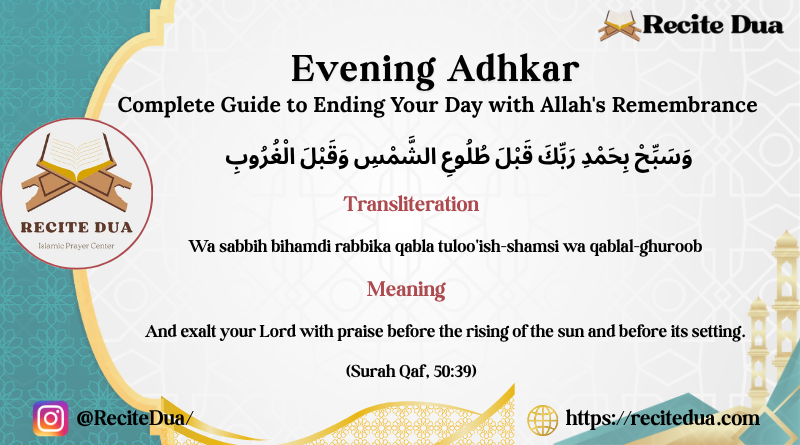
Arabic: وَسَبِّحْ بِحَمْدِ رَبِّكَ قَبْلَ طُلُوعِ الشَّمْسِ وَقَبْلَ الْغُرُوبِ
Transliteration: Wa sabbih bihamdi rabbika qabla tuloo’ish-shamsi wa qablal-ghuroob
Meaning: “And exalt your Lord with praise before the rising of the sun and before its setting.” (Surah Qaf, 50:39)
And in another verse that directly addresses the evening:
Arabic: وَاذْكُرِ اسْمَ رَبِّكَ بُكْرَةً وَأَصِيلًا
Transliteration: Wadhkuris-ma rabbika bukratan wa aseela
Meaning: “And mention the name of your Lord morning and evening.” (Surah Al-Insan, 76:25)
These are not optional recommendations. They are Quranic commands — repeated again and again — to close the day the same way a believer opened it: with the name of Allah on their lips.
When Exactly Should You Recite Evening Adhkar?
Evening adhkar (Azkar al-Masa) are recited after Asr prayer until Maghrib. This is the prescribed window according to the majority of scholars. The Prophet ﷺ himself would engage in the remembrance of Allah during this time regularly.
If you miss this window — perhaps because of work, travel, or simply forgetting — you can still recite the evening adhkar after Maghrib, and many scholars extend this until before going to sleep. The full reward is associated with the Asr-to-Maghrib window, but reciting them later is still valid and brings real benefit.
What you should avoid is skipping them entirely just because you missed the ideal time. A late evening adhkar is far better than no evening adhkar.
A note for working Muslims: If Asr falls during your work hours, you can recite the evening adhkar quietly at your desk, during a break, or during your commute home. Allah does not restrict His remembrance to prayer mats and mosques. The point is consistency — not perfect conditions.
The Complete Evening Adhkar — Arabic, Transliteration, Meaning and Source
1. Ayatul Kursi — The Anchor of the Evening
Just as Ayatul Kursi opens the morning adhkar, it opens the evening adhkar too. And for the same reason — it is the greatest verse of the Quran, and it establishes who is in charge of your night before anything else does.
Arabic: اللَّهُ لَا إِلَٰهَ إِلَّا هُوَ الْحَيُّ الْقَيُّومُ ۚ لَا تَأْخُذُهُ سِنَةٌ وَلَا نَوْمٌ ۚ لَّهُ مَا فِي السَّمَاوَاتِ وَمَا فِي الْأَرْضِ ۗ مَن ذَا الَّذِي يَشْفَعُ عِندَهُ إِلَّا بِإِذْنِهِ ۚ يَعْلَمُ مَا بَيْنَ أَيْدِيهِمْ وَمَا خَلْفَهُمْ ۖ وَلَا يُحِيطُونَ بِشَيْءٍ مِّنْ عِلْمِهِ إِلَّا بِمَا شَاءَ ۚ وَسِعَ كُرْسِيُّهُ السَّمَاوَاتِ وَالْأَرْضَ ۖ وَلَا يَئُودُهُ حِفْظُهُمَا ۚ وَهُوَ الْعَلِيُّ الْعَظِيمُ
Transliteration: Allahu la ilaha illa huwal-Hayyul-Qayyum, la ta’khudhuhu sinatun wa la nawm, lahu ma fis-samawati wa ma fil-ard, man dhal-ladhee yashfa’u ‘indahu illa bi-idhnih, ya’lamu ma bayna aydihim wa ma khalfahum, wa la yuheetoona bi shay’im-min ‘ilmihi illa bima sha’, wasi’a kursiyyuhus-samawati wal-ard, wa la ya’ooduhu hifdhuhuma, wa huwal-‘Aliyyul-‘Adheem
Meaning: “Allah — there is no deity except Him, the Ever-Living, the Sustainer of existence. Neither drowsiness overtakes Him nor sleep. To Him belongs whatever is in the heavens and whatever is on the earth. Who is it that can intercede with Him except by His permission? He knows what is before them and what will be after them, and they encompass not a thing of His knowledge except for what He wills. His Kursi extends over the heavens and the earth, and their preservation tires Him not. And He is the Most High, the Most Great.”
Source: Surah Al-Baqarah 2:255 How many times: Once every evening Hadith: The Prophet ﷺ said: “Whoever recites Ayatul Kursi in the evening will be protected until the morning.” (An-Nasa’i, authenticated by Al-Albani)
Notice the specific wording — whoever says it in the evening will be protected until the morning. This is your nighttime shield, activated before the night even begins.
2. The Three Quls — Surah Al-Ikhlas, Al-Falaq and An-Nas
These three surahs are recited three times each in both the morning and the evening. In the evening, they serve as the closing shield — sealing the day and protecting the night ahead.
Surah Al-Ikhlas:
Arabic: قُلْ هُوَ ٱللَّهُ أَحَدٌ ٱللَّهُ ٱلصَّمَدُ لَمْ يَلِدْ وَلَمْ يُولَدْ وَلَمْ يَكُن لَّهُۥ كُفُوًا أَحَدٌ
Transliteration: Qul huwa Allahu ahad. Allahus-samad. Lam yalid wa lam yoolad. Wa lam yakun lahu kufuwan ahad.
Meaning: “Say: He is Allah, the One. Allah, the Eternal Refuge. He neither begets nor is born, nor is there to Him any equivalent.”
Surah Al-Falaq:
Arabic: قُلْ أَعُوذُ بِرَبِّ الْفَلَقِ مِن شَرِّ مَا خَلَقَ وَمِن شَرِّ غَاسِقٍ إِذَا وَقَبَ وَمِن شَرِّ النَّفَّاثَاتِ فِي الْعُقَدِ وَمِن شَرِّ حَاسِدٍ إِذَا حَسَدَ
Transliteration: Qul a’oodhu bi-rabbil-falaq. Min sharri ma khalaq. Wa min sharri ghasiqin idha waqab. Wa min sharrin-naffathaati fil-‘uqad. Wa min sharri haasidin idha hasad.
Meaning: “Say: I seek refuge in the Lord of daybreak, from the evil of what He has created, and from the evil of darkness when it settles, and from the evil of the blowers in knots, and from the evil of an envier when he envies.”
Surah An-Nas:
Arabic: قُلْ أَعُوذُ بِرَبِّ النَّاسِ مَلِكِ النَّاسِ إِلَٰهِ النَّاسِ مِن شَرِّ الْوَسْوَاسِ الْخَنَّاسِ الَّذِي يُوَسْوِسُ فِي صُدُورِ النَّاسِ مِنَ الْجِنَّةِ وَالنَّاسِ
Transliteration: Qul a’oodhu bi-rabbin-naas. Malikin-naas. Ilaahin-naas. Min sharril-waswaasil-khannaas. Alladhi yuwaswisu fee sudoorin-naas. Minal-jinnati wan-naas.
Meaning: “Say: I seek refuge in the Lord of mankind, the Sovereign of mankind, the God of mankind, from the evil of the retreating whisperer, who whispers into the hearts of mankind, from among jinn and mankind.”
Source: Abu Dawud 5082, Tirmidhi 3575 How many times: Each surah three times in the evening Hadith: The Prophet ﷺ said: “Recite Qul Huwa Allahu Ahad and the Mu’awwidhat three times in the morning and evening, and they will suffice you against everything.” (Classed as Sahih by An-Nawawi)
3. Amsayna Wa Amsal Mulku Lillah — Evening Declaration of Sovereignty
This is the evening version of the morning declaration — Asbahna wa Asbahal Mulku Lillah. In the morning you declare that the day belongs to Allah. In the evening you declare that the night belongs to Allah too. Nothing is outside His dominion. Not a single hour of your life belongs to anyone other than Him.
Arabic: أَمْسَيْنَا وَأَمْسَى الْمُلْكُ لِلَّهِ، وَالْحَمْدُ لِلَّهِ، لَا إِلَهَ إِلَّا اللَّهُ وَحْدَهُ لَا شَرِيكَ لَهُ، لَهُ الْمُلْكُ وَلَهُ الْحَمْدُ وَهُوَ عَلَى كُلِّ شَيْءٍ قَدِيرٌ، رَبِّ أَسْأَلُكَ خَيْرَ مَا فِي هَذِهِ اللَّيْلَةِ وَخَيْرَ مَا بَعْدَهَا، وَأَعُوذُ بِكَ مِنْ شَرِّ مَا فِي هَذِهِ اللَّيْلَةِ وَشَرِّ مَا بَعْدَهَا، رَبِّ أَعُوذُ بِكَ مِنَ الْكَسَلِ وَسُوءِ الْكِبَرِ، رَبِّ أَعُوذُ بِكَ مِنْ عَذَابٍ فِي النَّارِ وَعَذَابٍ فِي الْقَبْرِ
Transliteration: Amsayna wa amsal-mulku lillah, walhamdu lillah, la ilaha illallahu wahdahu la shareeka lah, lahul-mulku wa lahul-hamd, wa huwa ‘ala kulli shay’in qadeer. Rabbi as’aluka khayra ma fee hadhihil-laylati wa khayra ma ba’daha, wa a’oothu bika min sharri ma fee hadhihil-laylati wa sharri ma ba’daha. Rabbi a’oothu bika minal-kasali wa soo-il-kibar. Rabbi a’oothu bika min ‘adhabin fin-nari wa ‘adhabin fil-qabr.
Meaning: “We have entered the evening and the entire dominion belongs to Allah. All praise is for Allah. There is no deity worthy of worship except Allah, alone, without partner. To Him belongs the dominion and all praise. And He is over all things capable. My Lord, I ask You for the goodness of this night and the goodness of what follows it. And I seek refuge in You from the evil of this night and the evil of what follows it. My Lord, I seek refuge in You from laziness and the misery of old age. My Lord, I seek refuge in You from the punishment of the Fire and the punishment of the grave.”
Source: Sahih Muslim 2723, Abu Dawud 5071 How many times: Once every evening
Notice how this dua already includes a request for protection from the punishment of the grave — something that is specifically relevant to the evening, as sleep is considered the minor death. The scholars mention that this is why the Prophet ﷺ included it in the evening adhkar specifically.
4. Sayyid Al-Istighfar — The Master of Seeking Forgiveness
This dua appears in both the morning and evening adhkar — and with good reason. The Prophet ﷺ promised Jannah for whoever recites it in the evening with sincere conviction. No matter what the day held, this single dua hands it all to Allah and asks for His cover.
Arabic: اللَّهُمَّ أَنْتَ رَبِّي لَا إِلَهَ إِلَّا أَنْتَ، خَلَقْتَنِي وَأَنَا عَبْدُكَ، وَأَنَا عَلَى عَهْدِكَ وَوَعْدِكَ مَا اسْتَطَعْتُ، أَعُوذُ بِكَ مِنْ شَرِّ مَا صَنَعْتُ، أَبُوءُ لَكَ بِنِعْمَتِكَ عَلَيَّ، وَأَبُوءُ لَكَ بِذَنْبِي فَاغْفِرْ لِي فَإِنَّهُ لَا يَغْفِرُ الذُّنُوبَ إِلَّا أَنْتَ
Transliteration: Allahumma anta rabbee la ilaha illa ant, khalaqtanee wa ana ‘abduka, wa ana ‘ala ‘ahdika wa wa’dika mas-tata’t, a’oothu bika min sharri ma sana’t, aboo-u laka bini’matika ‘alayya, wa aboo-u laka bidhanbee faghfir lee fa innahu la yaghfirudh-dhunooba illa ant
Meaning: “O Allah, You are my Lord. There is no deity worthy of worship except You. You created me and I am Your slave. I am keeping my covenant and my pledge to You as best I can. I seek refuge in You from the evil of what I have done. I acknowledge Your blessings upon me and I confess my sins to You. So forgive me, for indeed none forgives sins except You.”
Source: Sahih al-Bukhari 6306 How many times: Once every evening with full reflection and conviction Hadith: The Prophet ﷺ said: “Whoever says this in the evening with conviction and dies before the morning will be from the people of Jannah.” (Sahih al-Bukhari 6306)
Read this one slowly. Do not rush it. Every phrase is a complete act of honesty before Allah — an acknowledgement of who He is, who you are, what you have done, and what you need. That is the essence of a true servant.
5. Bismillahil-Ladhi La Yadurru — Nighttime Protection
The same dua from the morning adhkar now seals the evening. Whoever recites it three times before the night begins is promised protection from every sudden affliction until the morning.
Arabic: بِسْمِ اللَّهِ الَّذِي لَا يَضُرُّ مَعَ اسْمِهِ شَيْءٌ فِي الْأَرْضِ وَلَا فِي السَّمَاءِ وَهُوَ السَّمِيعُ الْعَلِيمُ
Transliteration: Bismillahil-ladhee la yadurru ma’asmihi shay’un fil-ardi wa la fis-sama’i wa huwas-Samee’ul-‘Aleem
Meaning: “In the name of Allah, with whose name nothing can cause harm in the earth or in the heavens, and He is the All-Hearing, the All-Knowing.”
Source: Abu Dawud 5088, Tirmidhi 3388, Ibn Majah 3869 How many times: Three times every evening Hadith: The Prophet ﷺ said: “Whoever says this three times in the evening will not be struck by any sudden affliction until the morning.” (Classed as Sahih by Al-Albani)
6. Allahumma Ma Amsa Bee — Evening Dua of Gratitude
This is the evening version of the morning gratitude dua. Where the morning version thanks Allah for the blessings of the day, this one thanks Him for the blessings of the evening and the night that follows. The wording changes from asbaha(morning) to amsa (evening) — but the spirit is identical: everything I have is from You alone.
Arabic: اللَّهُمَّ مَا أَمْسَى بِي مِنْ نِعْمَةٍ أَوْ بِأَحَدٍ مِنْ خَلْقِكَ فَمِنْكَ وَحْدَكَ لَا شَرِيكَ لَكَ، فَلَكَ الْحَمْدُ وَلَكَ الشُّكْرُ
Transliteration: Allahumma ma amsa bee min ni’matin aw bi-ahadin min khalqika faminka wahdaka la shareeka lak, falakal hamdu wa lakash shukr
Meaning: “O Allah, whatever blessings I or any of Your creation have received this evening, they are only from You alone. You have no partner. So to You belongs all praise and to You belongs all thanks.”
Source: Abu Dawud 5073, Ibn Hibban How many times: Once every evening Hadith: The Prophet ﷺ said: “Whoever says this in the evening has indeed offered his night’s thanks.” (Authenticated by Al-Albani)
Allah says in the Quran: “If you are grateful, I will certainly give you more.” (Ibrahim 14:7). This dua activates that promise every single evening.
7. Allahumma Bika Amsayna — Dua of Complete Reliance
This is a short but profound dua of total reliance on Allah. Everything — the evening, life, death, and the return to Him — is acknowledged in just a few words. The Prophet ﷺ taught this dua to his companions specifically for the evening.
Arabic: اللَّهُمَّ بِكَ أَمْسَيْنَا، وَبِكَ أَصْبَحْنَا، وَبِكَ نَحْيَا، وَبِكَ نَمُوتُ، وَإِلَيْكَ الْمَصِيرُ
Transliteration: Allahumma bika amsayna, wa bika asbahna, wa bika nahya, wa bika namootu, wa ilaykal-maseer
Meaning: “O Allah, by You we have entered the evening, and by You we enter the morning, and by You we live, and by You we die, and to You is the final return.”
Source: Tirmidhi 3391, Abu Dawud 5068 How many times: Once every evening Note: In the morning version of this dua, the wording begins with asbahna (we have entered the morning). In the evening, it begins with amsayna (we have entered the evening). The Prophet ﷺ taught both versions to his companions.
8. Amsayna ‘Ala Fitratil-Islam — Evening Declaration of Faith
Before the night begins, you declare your identity one more time. You are a Muslim. You are upon the fitrah — the natural instinct of tawheed. You are upon the religion of Ibrahim and Muhammad ﷺ. No matter what the day tried to tell you about yourself, this dua corrects the record.
Arabic: أَمْسَيْنَا عَلَى فِطْرَةِ الإِسْلَامِ، وَعَلَى كَلِمَةِ الإِخْلَاصِ، وَعَلَى دِينِ نَبِيِّنَا مُحَمَّدٍ صَلَّى اللَّهُ عَلَيْهِ وَسَلَّمَ، وَعَلَى مِلَّةِ أَبِينَا إِبْرَاهِيمَ حَنِيفًا مُسْلِمًا وَمَا كَانَ مِنَ الْمُشْرِكِينَ
Transliteration: Amsayna ‘ala fitratil-Islam, wa ‘ala kalimati-l-ikhlas, wa ‘ala deeni nabiyyina Muhammadin sallallahu ‘alayhi wa sallam, wa ‘ala millati abeena Ibraheema haneefan musliman wa ma kana minal-mushrikeen
Meaning: “We have entered the evening upon the natural instinct of Islam, upon the word of sincere faith, upon the religion of our Prophet Muhammad (peace be upon him), and upon the way of our father Ibrahim, who was a Muslim of pure faith and was not of those who associate partners with Allah.”
Source: Ahmad 15377, authenticated as Hasan by Al-Albani How many times: Once every evening
9. Allahumma ‘Afini Fi Badani — Evening Dua for Wellbeing
This comprehensive dua for physical and sensory health appears in both the morning and evening adhkar. In the evening it takes on an added dimension — you are not just asking for health during the day ahead. You are asking for protection through the night, through sleep, and into the morning.
Arabic: اللَّهُمَّ عَافِنِي فِي بَدَنِي، اللَّهُمَّ عَافِنِي فِي سَمْعِي، اللَّهُمَّ عَافِنِي فِي بَصَرِي، لَا إِلَهَ إِلَّا أَنْتَ
Transliteration: Allahumma ‘afini fee badanee, Allahumma ‘afini fee sam’ee, Allahumma ‘afini fee basaree, la ilaha illa ant
Meaning: “O Allah, grant me health in my body. O Allah, grant me health in my hearing. O Allah, grant me health in my sight. There is no deity worthy of worship except You.”
Source: Abu Dawud 5090, authenticated by Al-Albani How many times: Three times every evening
10. Allahumma Inni As’aluka Al-Afwa Wal-‘Afiyah — Dua for Forgiveness and Wellbeing
This is one of the most comprehensive evening duas in the entire Sunnah. It asks for both forgiveness (afw) and complete wellbeing (afiyah) — in religion, in worldly life, in family, and in wealth. Ibn Umar (may Allah be pleased with him) reported that the Prophet ﷺ never missed this dua in the morning or evening.
Arabic: اللَّهُمَّ إِنِّي أَسْأَلُكَ الْعَفْوَ وَالْعَافِيَةَ فِي الدُّنْيَا وَالْآخِرَةِ، اللَّهُمَّ إِنِّي أَسْأَلُكَ الْعَفْوَ وَالْعَافِيَةَ فِي دِينِي وَدُنْيَايَ وَأَهْلِي وَمَالِي، اللَّهُمَّ اسْتُرْ عَوْرَاتِي وَآمِنْ رَوْعَاتِي، اللَّهُمَّ احْفَظْنِي مِنْ بَيْنِ يَدَيَّ وَمِنْ خَلْفِي وَعَنْ يَمِينِي وَعَنْ شِمَالِي وَمِنْ فَوْقِي، وَأَعُوذُ بِعَظَمَتِكَ أَنْ أُغْتَالَ مِنْ تَحْتِي
Transliteration: Allahumma innee as’alukal-‘afwa wal-‘afiyata fid-dunya wal-akhirah. Allahumma innee as’alukal-‘afwa wal-‘afiyata fee deenee wa dunyaya wa ahlee wa maalee. Allahumas-tur ‘awraatee wa aamin raw’aatee. Allahummah-fadhnee min bayni yadayya wa min khalfee wa ‘an yameenee wa ‘an shimaalee wa min fawqee, wa a’oothu bi’adhamatika an ughtala min tahtee
Meaning: “O Allah, I ask You for forgiveness and wellbeing in this world and the Hereafter. O Allah, I ask You for forgiveness and wellbeing in my religion and my worldly affairs, and in my family and my wealth. O Allah, conceal my faults and calm my fears. O Allah, guard me from in front of me and behind me, from my right and my left, and from above me, and I seek refuge in Your greatness from being struck from below me.”
Source: Abu Dawud 5074, Ibn Majah 3871 — reported by Abdullah ibn Umar (may Allah be pleased with him). Authenticated by Al-Albani. How many times: Once every evening
This dua asks Allah to guard you from all six directions — front, back, right, left, above, and below. It is a complete spatial shield around you for the night. No competitor post covers the depth of this dua, which is why it is one of the most underrated duas in the entire evening adhkar.
11. Subhanallah Wa Bihamdihi — The Hundred Times Tasbih
Just as the morning ends with 100 repetitions of this short but powerful tasbih, the evening closes the same way. The Prophet ﷺ said that no one on the Day of Resurrection will bring better deeds than the person who said this — unless they said more.
Arabic: سُبْحَانَ اللَّهِ وَبِحَمْدِهِ
Transliteration: Subhanallahi wa bihamdih
Meaning: “Glory is to Allah and all praise is to Him.”
Source: Sahih al-Bukhari 6405, Sahih Muslim 2692 How many times: 100 times every evening Hadith: The Prophet ﷺ said: “Whoever says ‘Glory is to Allah and all praise is to Him’ one hundred times in the morning and evening, no one will come on the Day of Resurrection with better deeds than his — except for someone who said the same or said more.”(Sahih Muslim 2692)
If 100 times feels like a lot, use your fingers or a tasbih counter. At a comfortable pace this takes no more than 3 minutes — and the reward is one of the most remarkable in the entire Sunnah.
Your Complete Evening Adhkar Routine (10 to 15 Minutes)
Here is a practical sequence for your evening adhkar, best performed after Asr prayer:
- Ayatul Kursi — once
- Surah Al-Ikhlas — three times
- Surah Al-Falaq — three times
- Surah An-Nas — three times
- Amsayna wa amsal-mulku lillah — once
- Sayyid al-Istighfar — once (slowly, with reflection)
- Bismillahil-ladhee la yadurru — three times
- Allahumma ma amsa bee — once
- Allahumma bika amsayna — once
- Amsayna ‘ala fitratil-Islam — once
- Allahumma ‘afini fi badani — three times
- Allahumma innee as’alukal-‘afwa — once
- Subhanallahi wa bihamdih — 100 times
Total time: 10 to 15 minutes. That is the cost of a complete evening shield — protection through the night, gratitude for the day, and your heart cleaned and reset before sleep.
Shortcut for beginners: If you cannot manage the full list yet, begin with Ayatul Kursi, the three Quls, and Sayyid al-Istighfar. Add one new dhikr each week until you are doing the full routine. Consistency beats completeness every single time.
The Evening Adhkar and Sleep — A Special Connection
There is a reason the scholars placed so much emphasis on the evening adhkar specifically. Unlike the morning adhkar — which prepare you for a day in which you are conscious and active — the evening adhkar prepare you for sleep, during which you are vulnerable in a way you are not during the day.
The Prophet ﷺ described sleep as a minor death. Your soul is taken from you and returned by Allah’s permission. That is not a metaphor — it is described as such in the Quran:
Arabic: اللَّهُ يَتَوَفَّى الْأَنفُسَ حِينَ مَوْتِهَا وَالَّتِي لَمْ تَمُتْ فِي مَنَامِهَا
Transliteration: Allahu yatawaffal-anfusa heena mawtihaa wal-latee lam tamut fee manamihaa
Meaning: “Allah takes the souls at the time of their death, and those that do not die during their sleep.” (Surah Az-Zumar, 39:42)
Knowing this, the evening adhkar become something more than a routine. They are your preparation for a moment of complete submission to Allah — handing yourself over to His care for the night, trusting that He will return your soul to you in the morning.
This is why Sayyid al-Istighfar is so important in the evening specifically. If the night takes you before the morning comes, the last thing you said was a sincere acknowledgement of your slavery to Allah and a request for His forgiveness. There is no better way to leave this world.
What Makes the Evening Adhkar Different from the Morning Adhkar?
Many Muslims ask why some duas appear in both morning and evening adhkar. The answer is that while the duas are sometimes the same or very similar, the intention and context are different.
The morning adhkar are about opening — opening the day, seeking protection for what lies ahead, expressing gratitude for waking up, and declaring your reliance on Allah before the world makes its demands on you.
The evening adhkar are about closing — closing the day with accountability, seeking forgiveness for what passed, expressing gratitude for surviving the day, and placing yourself under Allah’s protection for the vulnerable hours of the night.
Even the language shifts. In the morning duas, the word asbahna (we have entered the morning) is used. In the evening duas, it becomes amsayna (we have entered the evening). This is not a small detail — it shows how precisely the Prophet ﷺ calibrated each dua to its moment.
What If You Miss Evening Adhkar?
The best time for the evening adhkar is between Asr and Maghrib. However, if anyone is unable to recite them during this time, they can make up for them later. If we cannot recite them all, we should be consistent with at least some of them. recitedua
The worst outcome is giving up entirely because you missed the ideal window. If you missed the Asr-to-Maghrib window, recite them after Maghrib. If you missed that, recite them before sleeping. Missing the optimal time is not a failure — stopping altogether is.
Frequently Asked Questions About Evening Adhkar
What is sham ki dua in Islam?
Sham ki dua is the Urdu term for the evening adhkar — the set of supplications recited after Asr prayer until Maghrib. This is the same as Adhkar al-Masa in Arabic. The complete list of sham ki duas is exactly what is covered in this guide, each with Arabic text, transliteration and meaning.
Can I recite evening adhkar after Maghrib?
Yes. While the ideal time is between Asr and Maghrib, scholars agree that reciting the evening adhkar after Maghrib is still valid. Many people find it more practical to recite them right after Maghrib prayer, and this is a well-accepted practice.
Is Ayatul Kursi recited in both morning and evening adhkar?
Yes — Ayatul Kursi is recited once in both the morning and evening adhkar. For the morning, the Hadith promises protection until the evening. For the evening, it promises protection until the morning. Together, they form a complete 24-hour shield.
Do I need to be in a state of wudu for evening adhkar?
It is recommended but not a strict condition. The evening adhkar are best recited right after Asr prayer when you are likely already in a state of wudu. If you are not, you may still recite the adhkar — the reward and protection are not conditional on wudu.
Can women recite evening adhkar during menstruation?
Yes, absolutely. Dhikr, dua, and the adhkar — including reciting Quranic verses as dua or dhikr — are all permissible during menstruation according to the majority of scholars. The restriction applies only to reciting the Quran with the formal intention of Quranic recitation.
How is the evening adhkar different from the adhkar before sleeping?
The evening adhkar are recited after Asr until Maghrib, or at most until before sleeping. The sleeping adhkar — such as Ayatul Kursi before bed, reciting the three Quls and blowing on the hands, and Dua before sleeping — are a separate set recited specifically at the moment of lying down to sleep. Both sets are from the Sunnah and both are recommended.
What does Adhkar al-Masa mean?
Adhkar al-Masa (أذكار المساء) is the Arabic term for the evening adhkar — literally “the remembrances of the evening.” It is the same as what is referred to in Urdu as sham ki dua or shaam ke azkar. This complete guide covers the full Adhkar al-Masa as compiled in Hisnul Muslim.
A Final Word
The day is done. Whatever it brought — its joys, its frustrations, its moments of weakness and its moments of strength — it is over. And now, before the night truly begins, you have a few minutes to sit with Allah.
That is what the evening adhkar are. Not a performance. Not a list of boxes to tick. A few minutes of genuine conversation with the One who watched every moment of your day, who knew every thought you had, who was with you even when you forgot He was there.
The Prophet ﷺ never let a night begin without these words on his lips. Not because he needed reminding of Allah — but because he understood that a night begun without remembrance of Allah is a night spent alone. And we were not created to be alone.
Begin tonight. If you know only Ayatul Kursi and Sayyid al-Istighfar, begin with those. Add one new dhikr each week. Make it a habit before it becomes an obligation — because the habits that begin with love are the ones that last.
May Allah accept your evening remembrances, protect you through the night, and return your soul to you in the morning with His mercy. Ameen.
All duas in this article have been verified from Hisnul Muslim by Sheikh Sa’id al-Qahtani, Sahih al-Bukhari, Sahih Muslim, Sunan Abu Dawud, and Jami’ al-Tirmidhi. Published on ReciteDua.com — your trusted source for authentic Islamic supplications.
→ Also read: Morning Adhkar: The Complete Step-by-Step Guide | Dua Before Sleeping — Sunnah Method