
Most people wake up and immediately reach for their phone. Within minutes, the mind is already full of notifications, news and noise — and whatever peace Fajr brought vanishes before it had a chance to settle.
The Prophet Muhammad ﷺ did something different. Every single morning, without fail, he sat after Fajr and remembered Allah before anything else could claim his attention. He did this on easy days and hard ones, on days of victory and days of grief.
These morning remembrances — called Adhkar al-Sabah in Arabic — are not complicated rituals reserved for scholars. They are short, practical, deeply powerful supplications that any Muslim can learn and recite in under 15 minutes every morning.
In this complete guide, you will find every major morning adhkar with the full Arabic text, transliteration, English meaning, authentic Hadith source, and a clear explanation of why each one matters. Every dua here has been verified from Hisnul Muslim (Fortress of the Muslim) and cross-referenced with the original hadith collections — Sahih Bukhari, Sahih Muslim, Abu Dawud and Tirmidhi.
Let us begin. Bismillah.
What Are Morning Adhkar?
The word Adhkar (أذكار) is the plural of Dhikr — meaning the remembrance of Allah. Morning Adhkar, or Adhkar al-Sabah, refers specifically to the set of supplications and phrases narrated from the Prophet ﷺ that a Muslim is encouraged to recite after Fajr prayer — ideally before leaving the prayer area or before the demands of the day begin.
These are not invented phrases. Every word has a source. Every benefit mentioned comes from an authentic narration. This is what separates these adhkar from general dua — they carry the authority of the Sunnah.
Allah commands this practice directly in the Quran in over fifteen places. In one verse He says:
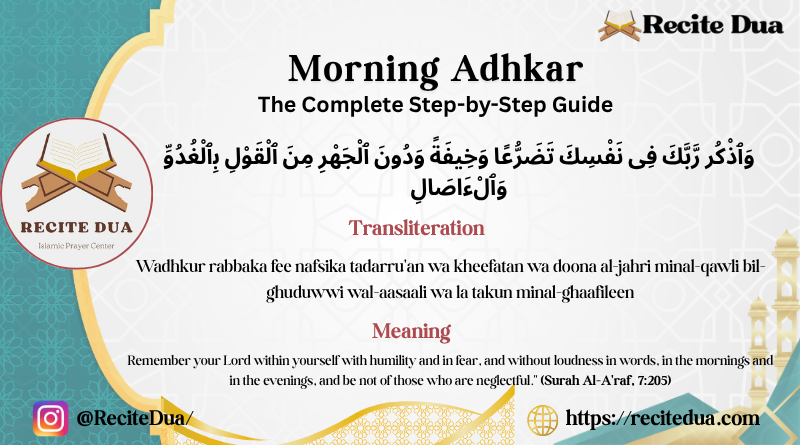
Arabic: وَٱذْكُر رَّبَّكَ فِى نَفْسِكَ تَضَرُّعًا وَخِيفَةً وَدُونَ ٱلْجَهْرِ مِنَ ٱلْقَوْلِ بِٱلْغُدُوِّ وَٱلْءَاصَالِ
Transliteration: Wadhkur rabbaka fee nafsika tadarru’an wa kheefatan wa doona al-jahri minal-qawli bil-ghuduwwi wal-aasaali wa la takun minal-ghaafileen
Meaning: “Remember your Lord within yourself with humility and in fear, and without loudness in words, in the mornings and in the evenings, and be not of those who are neglectful.”
(Surah Al-A’raf, 7:205)
And in another powerful verse:
Arabic: يَـٰٓأَيُّهَا ٱلَّذِينَ ءَامَنُوا۟ ٱذْكُرُوا۟ ٱللَّهَ ذِكْرًا كَثِيرًا وَسَبِّحُوهُ بُكْرَةً وَأَصِيلًا
Transliteration: Ya ayyuhalladhina amanu udhkurullaha dhikran katheera wa sabbihoohu bukratan wa aseela
Meaning: “O you who have believed, remember Allah with much remembrance, and exalt Him morning and afternoon.”
(Surah Al-Ahzab, 33:41-42)
These are not gentle suggestions. They are direct commands from Allah — which is why the scholars throughout history placed such great emphasis on the morning and evening adhkar.
When Is the Best Time to Recite Morning Adhkar?
The best time for morning adhkar is immediately after Fajr prayer until sunrise. This blessed window — sometimes called the time of sabah — is when the Prophet ﷺ himself used to remain in his prayer place and engage in the remembrance of Allah before starting his day.
If you miss this window due to work, children or other responsibilities, most scholars say you can recite the morning adhkar up until Dhuhr time. The full reward is in the prescribed window, but reciting them later is still valid and beneficial.
Quick tip for beginners: If the full list feels overwhelming at first, start with just Ayatul Kursi and Sayyid al-Istighfar. Add one new adhkar each week. The Prophet ﷺ said:
The most beloved deeds to Allah are those done consistently, even if they are small.
(Sahih al-Bukhari 6464)
The Complete Morning Adhkar — Arabic, Transliteration, Meaning and Source
1. Ayatul Kursi — The Greatest Verse of the Quran
Recite this once after Fajr prayer. The Prophet ﷺ said that whoever recites Ayatul Kursi after every obligatory prayer, nothing stands between them and Jannah except death itself. It is also the single most powerful protection from Shaytan throughout the day.
Arabic: اللَّهُ لَا إِلَٰهَ إِلَّا هُوَ الْحَيُّ الْقَيُّومُ ۚ لَا تَأْخُذُهُ سِنَةٌ وَلَا نَوْمٌ ۚ لَّهُ مَا فِي السَّمَاوَاتِ وَمَا فِي الْأَرْضِ ۗ مَن ذَا الَّذِي يَشْفَعُ عِندَهُ إِلَّا بِإِذْنِهِ ۚ يَعْلَمُ مَا بَيْنَ أَيْدِيهِمْ وَمَا خَلْفَهُمْ ۖ وَلَا يُحِيطُونَ بِشَيْءٍ مِّنْ عِلْمِهِ إِلَّا بِمَا شَاءَ ۚ وَسِعَ كُرْسِيُّهُ السَّمَاوَاتِ وَالْأَرْضَ ۖ وَلَا يَئُودُهُ حِفْظُهُمَا ۚ وَهُوَ الْعَلِيُّ الْعَظِيمُ
Transliteration: Allahu la ilaha illa huwal-Hayyul-Qayyum, la ta’khudhuhu sinatun wa la nawm, lahu ma fis-samawati wa ma fil-ard, man dhalla-dhee yashfa’u ‘indahu illa bi-idhnih, ya’lamu ma bayna aydihim wa ma khalfahum, wa la yuheetoona bi shay’im-min ‘ilmihi illa bima sha’, wasi’a kursiyyuhus-samawati wal-ard, wa la ya’ooduhu hifdhuhuma, wa huwal-‘Aliyyul-‘Adheem
Meaning:
Allah — there is no deity except Him, the Ever-Living, the Sustainer of existence. Neither drowsiness overtakes Him nor sleep. To Him belongs whatever is in the heavens and whatever is on the earth. Who is it that can intercede with Him except by His permission? He knows what is before them and what will be after them, and they encompass not a thing of His knowledge except for what He wills. His Kursi extends over the heavens and the earth, and their preservation tires Him not. And He is the Most High, the Most Great.
Source: Surah Al-Baqarah 2:255
How many times: Once after each Fajr prayer
Hadith: The Prophet ﷺ said: “Whoever recites Ayatul Kursi after every obligatory prayer, nothing will prevent him from entering Jannah except death.” (An-Nasa’i, authenticated by Al-Albani)
2. The Three Quls — Surah Al-Ikhlas, Al-Falaq and An-Nas
These three short surahs form a complete shield of protection. The Prophet ﷺ was extremely consistent about this practice, describing it as sufficient protection against everything. Recite each one three times.
Surah Al-Ikhlas:
Arabic: قُلْ هُوَ ٱللَّهُ أَحَدٌ ٱللَّهُ ٱلصَّمَدُ لَمْ يَلِدْ وَلَمْ يُولَدْ وَلَمْ يَكُن لَّهُۥ كُفُوًا أَحَدٌ
Transliteration: Qul huwa Allahu ahad. Allahus-samad. Lam yalid wa lam yoolad. Wa lam yakun lahu kufuwan ahad.
Meaning: “Say: He is Allah, the One. Allah, the Eternal Refuge. He neither begets nor is born, nor is there to Him any equivalent.”
Surah Al-Falaq:
Arabic: قُلْ أَعُوذُ بِرَبِّ الْفَلَقِ مِن شَرِّ مَا خَلَقَ وَمِن شَرِّ غَاسِقٍ إِذَا وَقَبَ وَمِن شَرِّ النَّفَّاثَاتِ فِي الْعُقَدِ وَمِن شَرِّ حَاسِدٍ إِذَا حَسَدَ
Transliteration: Qul a’oodhu bi-rabbil-falaq. Min sharri ma khalaq. Wa min sharri ghasiqin idha waqab. Wa min sharrin-naffathaati fil-‘uqad. Wa min sharri haasidin idha hasad.
Meaning: “Say: I seek refuge in the Lord of daybreak, from the evil of what He has created, and from the evil of darkness when it settles, and from the evil of the blowers in knots, and from the evil of an envier when he envies.”
Surah An-Nas:
Arabic: قُلْ أَعُوذُ بِرَبِّ النَّاسِ مَلِكِ النَّاسِ إِلَٰهِ النَّاسِ مِن شَرِّ الْوَسْوَاسِ الْخَنَّاسِ الَّذِي يُوَسْوِسُ فِي صُدُورِ النَّاسِ مِنَ الْجِنَّةِ وَالنَّاسِ
Transliteration: Qul a’oodhu bi-rabbin-naas. Malikin-naas. Ilaahin-naas. Min sharril-waswaasil-khannaas. Alladhi yuwaswisu fee sudoorin-naas. Minal-jinnati wan-naas.
Meaning: “Say: I seek refuge in the Lord of mankind, the Sovereign of mankind, the God of mankind, from the evil of the retreating whisperer, who whispers into the hearts of mankind, from among jinn and mankind.”
Source: Abu Dawud 5082, Tirmidhi 3575
How many times: Each surah three times
Hadith: The Prophet ﷺ said: “Recite Qul Huwa Allahu Ahad and the Mu’awwidhat three times in the morning and evening, and they will suffice you against everything.” (Classed as Sahih by An-Nawawi in Al-Adhkar)
3. Sayyid Al-Istighfar — The Master of Seeking Forgiveness
This is called Sayyid al-Istighfar — the chief of all forgiveness duas. Pay careful attention to this one. The Prophet ﷺ attached a promise to it that is truly remarkable.
Arabic: اللَّهُمَّ أَنْتَ رَبِّي لَا إِلَهَ إِلَّا أَنْتَ، خَلَقْتَنِي وَأَنَا عَبْدُكَ، وَأَنَا عَلَى عَهْدِكَ وَوَعْدِكَ مَا اسْتَطَعْتُ، أَعُوذُ بِكَ مِنْ شَرِّ مَا صَنَعْتُ، أَبُوءُ لَكَ بِنِعْمَتِكَ عَلَيَّ، وَأَبُوءُ لَكَ بِذَنْبِي فَاغْفِرْ لِي فَإِنَّهُ لَا يَغْفِرُ الذُّنُوبَ إِلَّا أَنْتَ
Transliteration: Allahumma anta rabbee la ilaha illa ant, khalaqtanee wa ana ‘abduka, wa ana ‘ala ‘ahdika wa wa’dika mas-tata’t, a’oothu bika min sharri ma sana’t, aboo-u laka bini’matika ‘alayya, wa aboo-u laka bidhanbee faghfir lee fa innahu la yaghfirudh-dhunooba illa ant
Meaning: “O Allah, You are my Lord. There is no deity worthy of worship except You. You created me and I am Your slave. I am keeping my covenant and my pledge to You as best I can. I seek refuge in You from the evil of what I have done. I acknowledge Your blessings upon me and I confess my sins to You. So forgive me, for indeed none forgives sins except You.”
Source: Sahih al-Bukhari 6306 — narrated by Shaddad ibn Aws (may Allah be pleased with him)
How many times:Once every morning with full understanding and conviction
Hadith: The Prophet ﷺ said: “Whoever says this in the morning with conviction and dies that day before the evening will be from the people of Jannah. And whoever says it in the evening with conviction and dies before the morning will be from the people of Jannah.” (Sahih al-Bukhari 6306)
4. Bismillahil-Ladhi La Yadurru — Full Day Protection
This is one of the most powerful and underrated morning duas. Despite being just one line, the Prophet ﷺ attached an extraordinary promise to it — recite it three times in the morning and you will be protected from harm for the entire day.
Arabic: بِسْمِ اللَّهِ الَّذِي لَا يَضُرُّ مَعَ اسْمِهِ شَيْءٌ فِي الْأَرْضِ وَلَا فِي السَّمَاءِ وَهُوَ السَّمِيعُ الْعَلِيمُ
Transliteration: Bismillahil-ladhee la yadurru ma’asmihi shay’un fil-ardi wa la fis-sama’i wa huwas-Samee’ul-‘Aleem
Meaning: “In the name of Allah, with whose name nothing can cause harm in the earth or in the heavens, and He is the All-Hearing, the All-Knowing.”
Source: Abu Dawud 5088, Tirmidhi 3388, Ibn Majah 3869
How many times: Three times every morning
Hadith: The Prophet ﷺ said: “Whoever says this three times in the morning will not be struck by any sudden affliction until the evening, and whoever says it three times in the evening will not be struck by any sudden affliction until the morning.”(Classed as Sahih by Al-Albani)
This dua takes less than 20 seconds to recite three times. The Prophet ﷺ promised complete daily protection for it. There is no reason to miss this one.
5. Radeetu Billahi Rabba — Declaration of Contentment
This short but profound dua is a declaration that you are content with Allah as your Lord, Islam as your religion, and Muhammad ﷺ as your Prophet. It takes only a few seconds and yet the Prophet ﷺ guaranteed Allah’s pleasure for whoever says it sincerely.
Arabic: رَضِيتُ بِاللَّهِ رَبًّا، وَبِالْإِسْلَامِ دِينًا، وَبِمُحَمَّدٍ صَلَّى اللَّهُ عَلَيْهِ وَسَلَّمَ نَبِيًّا
Transliteration: Radeetu billahi rabba, wa bil-Islami deenan, wa bi-Muhammadin sallallahu ‘alayhi wa sallama nabiyya
Meaning: “I am pleased with Allah as my Lord, with Islam as my religion, and with Muhammad (peace be upon him) as my Prophet.”
Source: Abu Dawud 1529, Tirmidhi 3389, Ibn Majah 3870
How many times: Three times every morning
Hadith: The Prophet ﷺ said: “Whoever says this three times in the morning or evening, Allah has a right to please him on the Day of Judgment.” (Authenticated by Al-Albani)
6. Allahumma Ma Asbaha Bee — Dua of Morning Gratitude
This is a dua of complete gratitude to Allah at the start of the day. The Prophet ﷺ said that reciting it once in the morning fulfils your obligation of thanks for the entire day. Given that Allah has promised to increase whoever is grateful, this dua is also a means of attracting more blessings into your life.
Arabic: اللَّهُمَّ مَا أَصْبَحَ بِي مِنْ نِعْمَةٍ أَوْ بِأَحَدٍ مِنْ خَلْقِكَ فَمِنْكَ وَحْدَكَ لَا شَرِيكَ لَكَ، فَلَكَ الْحَمْدُ وَلَكَ الشُّكْرُ
Transliteration: Allahumma ma asbaha bee min ni’matin aw bi-ahadin min khalqika faminka wahdaka la shareeka lak, falakal hamdu wa lakash shukr
Meaning: “O Allah, whatever blessings I or any of Your creation have received this morning, they are only from You alone. You have no partner. So to You belongs all praise and to You belongs all thanks.”
Source: Abu Dawud 5073, Ibn Hibban
How many times: Once every morning
Hadith: The Prophet ﷺ said: “Whoever says this in the morning has offered his day’s thanks.” (Authenticated by Al-Albani)
7. Allahumma ‘Afini Fi Badani — Dua for Complete Wellbeing
This is a comprehensive morning dua asking Allah for complete health and protection — in body, hearing, sight and every sense. Despite being so short, it covers everything a human being could need in terms of physical and sensory wellbeing.
Arabic: اللَّهُمَّ عَافِنِي فِي بَدَنِي، اللَّهُمَّ عَافِنِي فِي سَمْعِي، اللَّهُمَّ عَافِنِي فِي بَصَرِي، لَا إِلَهَ إِلَّا أَنْتَ
Transliteration: Allahumma ‘afini fee badanee, Allahumma ‘afini fee sam’ee, Allahumma ‘afini fee basaree, la ilaha illa ant
Meaning: “O Allah, grant me health in my body. O Allah, grant me health in my hearing. O Allah, grant me health in my sight. There is no deity worthy of worship except You.”
Source: Abu Dawud 5090, authenticated by Al-Albani
How many times: Three times every morning and evening
8. Ya Hayyu Ya Qayyum — Dua for All Affairs
This is one of the most beloved duas of the Prophet ﷺ and the scholars who came after him. It uses two of the greatest names of Allah — Al-Hayy (The Ever-Living) and Al-Qayyum (The Self-Sustaining) — and asks Allah to set right every single affair of your life. It is an acknowledgement that without Allah, we cannot manage even for a moment.
Arabic: يَا حَيُّ يَا قَيُّومُ بِرَحْمَتِكَ أَسْتَغِيثُ، أَصْلِحْ لِي شَأْنِي كُلَّهُ وَلَا تَكِلْنِي إِلَى نَفْسِي طَرْفَةَ عَيْنٍ
Transliteration: Ya Hayyu ya Qayyomu birahmatika astagheth, aslih lee sha’nee kullahu wa la takilnee ila nafsee tarfata ‘ayn
Meaning: “O Ever-Living One, O Self-Sustaining One, in Your mercy I seek relief. Set all my affairs right and do not leave me to myself even for the blink of an eye.”
Source: Al-Hakim, authenticated as Sahih by Al-Albani (Sahih al-Jami 4366)
How many times: Once or three times every morning
9. Asbahna ‘Ala Fitratil-Islam — Declaration of Faith
This is a declaration of identity. Before the world defines who you are today, you declare it yourself — I am a Muslim, upon the fitrah of Islam, upon the religion of the Prophet ﷺ.
Arabic: أَصْبَحْنَا عَلَى فِطْرَةِ الإِسْلَامِ، وَعَلَى كَلِمَةِ الإِخْلَاصِ، وَعَلَى دِينِ نَبِيِّنَا مُحَمَّدٍ صَلَّى اللَّهُ عَلَيْهِ وَسَلَّمَ، وَعَلَى مِلَّةِ أَبِينَا إِبْرَاهِيمَ حَنِيفاً مُسْلِماً وَمَا كَانَ مِنَ الْمُشْرِكِينَ
Transliteration: Asbahna ‘ala fitratil-Islam, wa ‘ala kalimati-l-ikhlas, wa ‘ala deeni nabiyyina Muhammadin sallallahu ‘alayhi wa sallam, wa ‘ala millati abeena Ibraheema haneefan musliman wa ma kana minal-mushrikeen
Meaning: “We have entered the morning upon the natural instinct of Islam, upon the word of sincere faith, upon the religion of our Prophet Muhammad (peace be upon him), and upon the way of our father Ibrahim, who was a Muslim of pure faith and was not of those who associate partners with Allah.”
Source: Ahmad 15377, authenticated as Hasan by Al-Albani
How many times: Once every morning
10. Subhanallah Wa Bihamdihi — Hundred Times Tasbih
This final morning adhkar is the most rewarding in terms of sin erasure. Reciting it 100 times seems like a lot — but it takes less than three minutes if done at a steady pace.
Arabic: سُبْحَانَ اللَّهِ وَبِحَمْدِهِ
Transliteration: Subhanallahi wa bihamdih
Meaning: “Glory is to Allah and praise is to Him.”
Source: Sahih al-Bukhari 6405, Sahih Muslim 2692
How many times: 100 times every morning
Hadith: The Prophet ﷺ said: “Whoever says ‘Glory is to Allah and all praise is to Him’ one hundred times in the morning and evening, no one will come on the Day of Resurrection with better deeds than his — except for someone who said the same or said more.”(Sahih Muslim 2692)
Your Complete Morning Adhkar Routine (8 to 12 Minutes)
Here is the full morning adhkar in a practical sequence you can follow every day after Fajr:
- Ayatul Kursi — once
- Surah Al-Ikhlas — three times
- Surah Al-Falaq — three times
- Surah An-Nas — three times
- Sayyid al-Istighfar — once (read slowly with reflection)
- Bismillahil-ladhee la yadurru — three times
- Radeetu billahi rabba — three times
- Allahumma ma asbaha bee — once
- Allahumma ‘afini fi badani — three times
- Ya Hayyu ya Qayyum — three times
- Asbahna ‘ala fitratil-Islam — once
- Subhanallahi wa bihamdih — 100 times
Total time: 8 to 12 minutes maximum. Less than the time most people spend scrolling their phone after waking up — and infinitely more valuable.
What Happens If You Miss Morning Adhkar?
Life is not always perfectly timed. Some mornings you oversleep, children need you, or you are travelling. Here is what the scholars say:
If you miss the post-Fajr window, you can still recite the morning adhkar up until Dhuhr time. The full reward is attached to the prescribed morning window, but reciting them later is still valid and brings real benefit.
What you should avoid is skipping them entirely just because you missed the ideal time. A late morning adhkar is far better than no morning adhkar at all.
Imam Al-Nawawi (rahimahullah) wrote: “Whoever is granted the ability to perform the morning and evening adhkar has received a blessing and a favour from Allah upon him.”
Frequently Asked Questions About Morning Adhkar
Can women recite morning adhkar during their menstrual cycle?
Yes, they absolutely can. There is no prohibition on dhikr or dua during menstruation. The restriction in this period applies only to reciting Quran with the intention of Quranic recitation. General adhkar and duas are completely permissible.
Do I need wudu to recite morning adhkar?
It is recommended to be in a state of wudu, especially since morning adhkar follow Fajr prayer. However, it is not a strict condition. If you cannot make wudu in time, you may still recite the adhkar — the reward and protection are still there.
Is there a specific order for morning adhkar?
There is no single strictly prescribed order required. Most scholars recommend beginning with Ayatul Kursi and the three Quls as they are the strongest in protection. The order above reflects the commonly practiced sequence and is a solid structure to follow.
Can I recite morning adhkar in English if I do not know Arabic?
You may recite the meaning in your own language while you are learning the Arabic. However, work toward the Arabic text over time — the adhkar carry their full spiritual weight in the original language. Start with shorter ones like Radeetu billahi rabba, which is easy to memorise.
How long does the full morning adhkar routine take?
The complete routine takes between 8 and 15 minutes. Even a shortened version — Ayatul Kursi, the three Quls, and Sayyid al-Istighfar — takes only 3 to 4 minutes.
What is subah ki dua in Islam?
Subah ki dua refers to the morning supplications recited after Fajr prayer. This is the Urdu term for morning adhkar — the same duas described in full in this guide. They include Ayatul Kursi, the three Quls, Sayyid al-Istighfar, and other short but powerful remembrances.
Can I recite morning adhkar while commuting?
The ideal is to recite them in your place of prayer right after Fajr. But if that is not possible, yes — you can recite them quietly during your commute, at your desk, or anywhere you can focus. Allah does not restrict His remembrance to prayer mats alone.
A Final Word
The morning adhkar are not a checklist to rush through. They are a relationship — between you and Allah — that you renew at the start of every single day, before the world gets to define your morning for you.
The Prophet ﷺ, the most beloved man to ever walk this earth, still took 10 to 15 minutes every morning to sit and say these words. He did not skip them when he was busy. He did not rush through them when he was tired. If he needed them, we certainly do.
Start tomorrow morning. If you already know some of these adhkar, recommit to them with presence and understanding. If they are new to you, begin with Ayatul Kursi and Sayyid al-Istighfar and grow from there, one dhikr at a time.
May Allah grant you barakah in your mornings, protection throughout your days, and acceptance of your adhkar. Ameen.
All duas in this article have been verified from Hisnul Muslim by Sheikh Sa’id al-Qahtani, Sahih al-Bukhari, Sahih Muslim, Sunan Abu Dawud, and Jami’ al-Tirmidhi. Published on ReciteDua.com — your trusted source for authentic Islamic supplications.