
Every night, before the Prophet Muhammad ﷺclosed his eyes, he did something that took less than ten minutes. He prepared his bed, lay on his right side, and recited a set of duas and Quranic verses that transformed his sleep from a biological act into an act of worship.
Table of Contents
This is the power of the bedtime Sunnah — what is commonly known as sone ki dua in Urdu. It does not just help you sleep better. It places you under Allah’s direct protection for the night, earns you reward even while you are unconscious, and ensures that even if your soul is taken during sleep, your last words were the remembrance of Allah.
The Prophet ﷺ described sleep as a minor death. Your soul leaves your body and is returned to you by Allah’s permission in the morning. Knowing this, the duas before sleeping are not optional extras — they are your preparation for one of the most profound moments of surrender a believer experiences every single day.
In this complete guide, every dua is verified from Hisnul Muslim, Sahih Bukhari, and Sahih Muslim. The Arabic text, full transliteration, English meaning, and Hadith source are provided for each one.
The Sunnah Acts Before Sleeping
Before the specific duas, the Prophet ﷺ practiced several Sunnah acts that prepared him both physically and spiritually for sleep. These are:
- Perform wudu before sleeping — as if preparing for prayer. (Sahih Bukhari 247)
- Dust the bed three times with the edge of your garment before lying down. (Sahih Bukhari 6320)
- Lie on your right side and place your right hand under your right cheek. (Sahih Bukhari 247)
- Face the Qibla if possible.
- Reflect briefly on your day and seek forgiveness in your heart before reciting the duas.
These simple acts are the physical frame around the spiritual content of the bedtime routine. Together they make sleep an act of worship — ibadah — from the very moment you lie down.
The Complete Duas Before Sleeping — Arabic, Transliteration & Meaning
1. Bismika Rabbee Wadatu Janbee — The Core Bedtime Dua
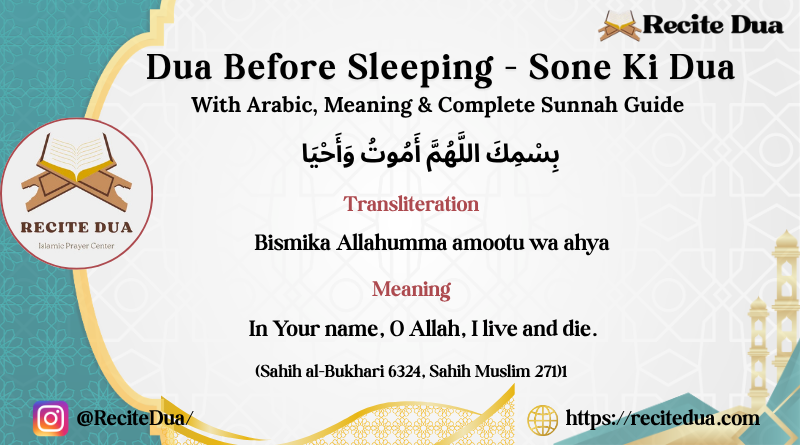
This is the primary dua before sleeping — the one the Prophet ﷺrecited most consistently every night. It is an acknowledgement that your life and death are entirely in Allah’s hands, and a request that He either protect your soul or show it mercy.
بِسْمِكَ اللَّهُمَّ أَمُوتُ وَأَحْيَا
Transliteration: Bismika Allahumma amootu wa ahya
Meaning: In Your name, O Allah, I live and die.
Sahih al-Bukhari 6324, Sahih Muslim 2711
How many times: Once, immediately before sleeping
Hadith : The Prophet ﷺused to say this when he went to his bed. (Sahih al-Bukhari 6324)
بِسْمِكَ رَبِّي وَضَعْتُ جَنْبِي وَبِكَ أَرْفَعُهُ فَإِنْ أَمْسَكْتَ نَفْسِي فَارْحَمْهَا وَإِنْ أَرْسَلْتَهَا فَاحْفَظْهَا بِمَا تَحْفَظُ بِهِ عِبَادَكَ الصَّالِحِينَ
Transliteration: Bismika rabbee wada’tu janbee, wa bika arfa’uh. Fa in amsakta nafsee farhamha, wa in arsaltaha fahfadhha bima tahfadhu bihi ‘ibaadakas-saaliheen
Meaning: In Your name my Lord, I lie down and in Your name I rise. So if You should take my soul then have mercy upon it, and if You should return my soul then protect it in the manner You do so with Your righteous servants.
Sahih al-Bukhari 6320, Sahih Muslim 2714
How many times: Once every night
2. The Three Quls — Blow on Hands and Wipe Over Body
The Prophet ﷺ had a specific method for reciting the three Quls before sleeping that is unique to bedtime. He would recite Surah Al-Ikhlas, Al-Falaq and An-Nas, then blow lightly into his cupped hands and wipe them over his entire body — starting from the face and going as far as possible. He repeated this three times.
Ibn Al-Qayyim (rahimahullah) said about these three surahs: “They are extremely effective in repelling magic, the evil eye, and all other evils. The need of a slave for these surahs is greater than his need for food, water, and clothing.”
قُلْ هُوَ اللَّهُ أَحَدٌ اللَّهُ الصَّمَدُ لَمْ يَلِدْ وَلَمْ يُولَدْ وَلَمْ يَكُن لَّهُ كُفُوًا أَحَدٌ
Transliteration: Qul huwa Allahu ahad, Allahus-samad, lam yalid wa lam yoolad, wa lam yakun lahu kufuwan ahad
Meaning: Say: He is Allah, the One. Allah, the Eternal Refuge. He neither begets nor is born, nor is there to Him any equivalent.
Then recite Surah Al-Falaq (113) and Surah An-Nas (114) in the same manner.
Source: Sahih al-Bukhari 5017
How many times: Each surah once, then blow on cupped hands and wipe over body — repeat three times
3. Ayatul Kursi — The Night Guard
If there is one dua before sleeping that you must not miss, it is this one. The Prophet ﷺpromised that whoever recites Ayatul Kursi before sleeping, Allah will appoint a guardian angel to protect them throughout the night and Shaytan will not come near them until morning.
اللَّهُ لَا إِلَٰهَ إِلَّا هُوَ الْحَيُْالْقَيُّومُ لَا تَأْخُذُهُ سِنَةٌ وَلَا نَوْمٌ لَّهُ مَا فِي السَّمَوَاتِ وَمَا فِي الأْرْضِ وَهُوَ الْعَلِيُّ الْعَظِيمُ
Transliteration: Allahu la ilaha illa huwal-Hayyul-Qayyum, la ta’khudhuhu sinatun wa la nawm, lahu ma fis-samawati wa ma fil-ard, man dhal-ladhee yashfa’u ‘indahu illa bi-idhnih, ya’lamu ma bayna aydihim wa ma khalfahum, wasi’a kursiyyuhus-samawati wal-ard, wa la ya’ooduhu hifdhuhuma, wa huwal-‘Aliyyul-‘Adheem
Meaning: Allah — there is no deity except Him, the Ever-Living, the Sustainer of existence. Neither drowsiness overtakes Him nor sleep. To Him belongs whatever is in the heavens and whatever is on the earth…
Source: Surah Al-Baqarah 2:255
How many times: Once before sleeping
Hadith: The Prophet ﷺsaid: Whoever recites Ayatul Kursi before sleeping, Allah will appoint a guardian over him and Shaytan will not come near him until morning. (Sahih al-Bukhari 2311)
4. Last Two Verses of Surah Al-Baqarah
Ali ibn Abi Talib (may Allah be pleased with him) said: “I do not think any reasonable person could sleep without reciting the last two verses of Surah Al-Baqarah, for they are indeed treasures from beneath the Throne.” These two verses are a comprehensive statement of faith and a prayer for mercy and forgiveness.
آمَنَ الرَّسُولُ بِمَا أُنزِلَ إِلَيْهِ مِن رَّبِّهِ وَالْمُؤْمِنُونَ كُلٌّ آمَنَ بِاللَّهِ وَمَلَائِكَتِهِ وَكُتُبِهِ وَرُسُلِهِ
Transliteration: Aamanar-rasoolu bima unzila ilayhi mir-rabbihi wal-mu’minoon, kullun amana billahi wa mala’ikatihi wa kutubihi wa rusulihi, la nufarriqu bayna ahadim-mir-rusulihi, wa qaloo sami’na wa ata’na ghufranaka rabbana wa ilaykal-maseer
Meaning: The Messenger has believed in what was revealed to him from his Lord, and so have the believers. All of them have believed in Allah and His angels and His books and His messengers, saying we make no distinction between any of His messengers, and they say we hear and we obey. We seek Your forgiveness, our Lord, and to You is the final destination.
Surah Al-Baqarah 2:285-286
How many times: Once every night
Hadith: The Prophet ﷺsaid: Whoever recites the last two verses of Surah Al-Baqarah at night, they will be sufficient for him. (Sahih al-Bukhari 5009, Sahih Muslim 808)
5. Tasbih Fatimah — The Gift Better Than a Servant
The story behind this dhikr is beautiful. Fatimah (may Allah be pleased with her), the daughter of the Prophet ﷺ, went to her father asking for a servant to help with the hard work of the household. He did not give her a servant — instead he gave her something better. He taught her this dhikr for bedtime, saying it is better for you than what you have asked for.
Recite Below as Given in Order:
Sahih al-Bukhari 3705, Sahih Muslim 2727
- Subhanallah (Glory be to Allah) — 33 times
- Alhamdulillah (All praise is for Allah) — 33 times
- Allahu Akbar (Allah is the Greatest) — 34 times
Hadith: The Prophet ﷺ said: This is better for you than a servant. (Sahih al-Bukhari 3705)
Imam Ali (may Allah be pleased with him) reported that after the Prophet ﷺ taught him this dhikr, he never missed it for a single night for the rest of his life — not even on the night of the Battle of Siffeen.
6. Dua for Protection from Nightmares
If you suffer from bad dreams, anxiety at night, or difficulty sleeping peacefully, the Prophet ﷺprescribed a specific method. Upon lying down, seek refuge in Allah from Shaytan with this phrase:
أَعُوذُ بِكَلِمَاتِ اللَّهِ التَّامَّاتِ مِنْ غَضَبِهِ وَعِقَابِهِ وَشَرِّ عِبَادِهِ وَمِنْ هَمَزَاتِ الشَّيَاطِينِ وَأَنْ يَحْضُرُونِ
Transliteration: A’oodhu bikalimaatillaahit-taammaati min ghadabihi wa ‘iqaabihi wa sharri ‘ibaadihi wa min hamazaatish-shayaateeni wa an yahdhuroon
Meaning: I seek refuge in the perfect words of Allah from His wrath and His punishment, from the evil of His servants and from the taunts of the devils and from their presence.
Abu Dawud 3893, authenticated by Al-Albani
How many times: Once before sleeping, especially when experiencing nightmares
Your Complete Bedtime Sunnah Routine
Here is the full sequence, best done after Isha prayer and immediately before closing your eyes:
- Make wudu
- Dust your bed three times with the edge of your garment
- Lie on your right side facing the Qibla
- Recite Bismika Allahumma amootu wa ahya — once
- Recite Bismika rabbee wada’tu janbee — once
- Recite the three Quls once each, blow on hands, wipe body — repeat three times
- Recite Ayatul Kursi — once
- Recite last two verses of Surah Al-Baqarah — once
- Recite Tasbih Fatimah: SubhanAllah x33, Alhamdulillah x33, Allahu Akbar x34
Total time: 8 to 12 minutes. This is the most protected and spiritually complete way a Muslim can fall asleep.
Frequently Asked Questions About Dua Before Sleeping
What is sone ki dua in Islam?
Sone ki dua is the Urdu term for the supplications recited before sleeping — also known as the bedtime adhkar. This includes Bismika Allahumma amootu wa ahya, the three Quls, Ayatul Kursi, and the last two verses of Surah Al-Baqarah, among others. This complete guide covers all the authentic sone ki duas with Arabic text, transliteration and meaning.
What is the most important dua before sleeping?
According to the Hadith, the most important is Bismika rabbee wada’tu janbee — the main bedtime dua of the Prophet ﷺ. Combined with Ayatul Kursi and the three Quls, these form the essential core of the bedtime routine that the Prophet ﷺ never missed.
Is it Sunnah to sleep with wudu?
Yes. The Prophet ﷺ instructed believers to perform wudu before sleeping as reported in Sahih al-Bukhari. Wudu before sleep is a confirmed Sunnah that is highly recommended. If it is not possible every night, one should try to maintain it as much as possible.
What should I do if I have a bad dream after reciting the bedtime duas?
The Sunnah method is: spit drily to your left three times without saliva, say A’oodhu billahi minash-Shaytanir-Rajeem, change your sleeping position if possible, and do not share or speak about the dream. Do not be alarmed — the Prophet ﷺ said bad dreams are from Shaytan and will not harm you if you follow this method. (Sahih Muslim 2261)
Can children recite the bedtime duas?
Absolutely. Teaching children the bedtime Sunnah is one of the best Islamic habits a parent can instill. Start with the simple Bismika Allahumma amootu wa ahya, then add Ayatul Kursi and the three Quls as they grow. These duas place even children under Allah’s protection every night.
A Final Word
Every night you sleep is a rehearsal. The Prophet ﷺ understood this. He knew that laying your head down without the remembrance of Allah is leaving yourself exposed — spiritually, not just physically.
These duas take less than twelve minutes. They cost nothing. They require no equipment and no special knowledge. And they carry the promise of Allah’s protection, an angel standing guard, and reward continuing even while you sleep.
Start tonight. May Allah protect you through every night and return your soul to you with His mercy. Ameen.
All duas are halal and verified from Hisnul Muslim, Sahih al-Bukhari, Sahih Muslim and Sunan Abu Dawud. Published on ReciteDua.com.